
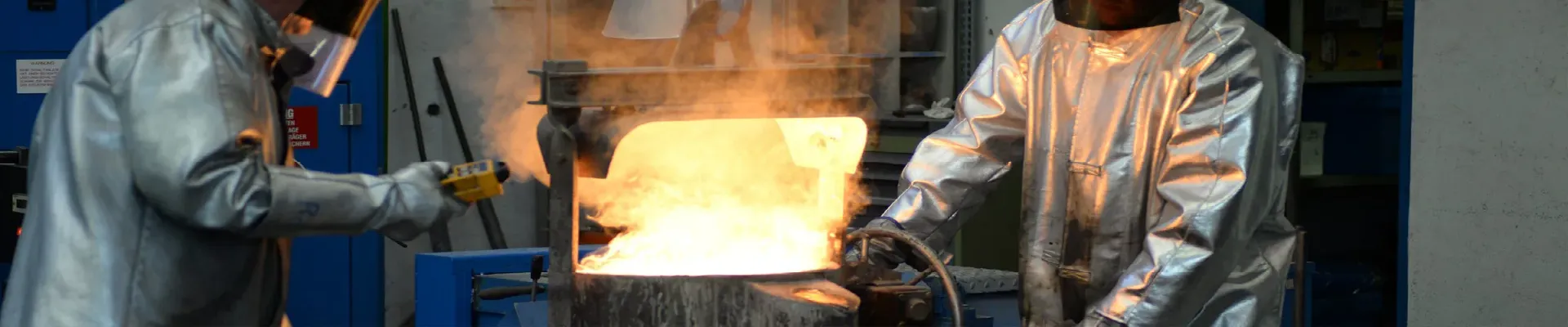
In sand casting (also known as lost mould casting), molten metal is poured into a mould, usually made of moulding material (sand, binder and additives). In the course of casting, the mould is subjected to such high thermal and mechanical stresses that it looses its initial strength and can therefore only be used once.
A pattern (sample of the casting to be produced) is required for moulding, which must be produced with an allowance to compensate for shrinkage of the casting material when it cools in the solid state. To compensate for shrinkage in the liquid state and during solidification, one or more risers are usually set, depending on the casting alloy used. So-called core patterns are often used to create complex internal contours and cavities. Castings are always moulded at least on both sides, so that the mould is composed of two moulding boxes, the lower and upper box, to enable the pattern to be removed before casting.